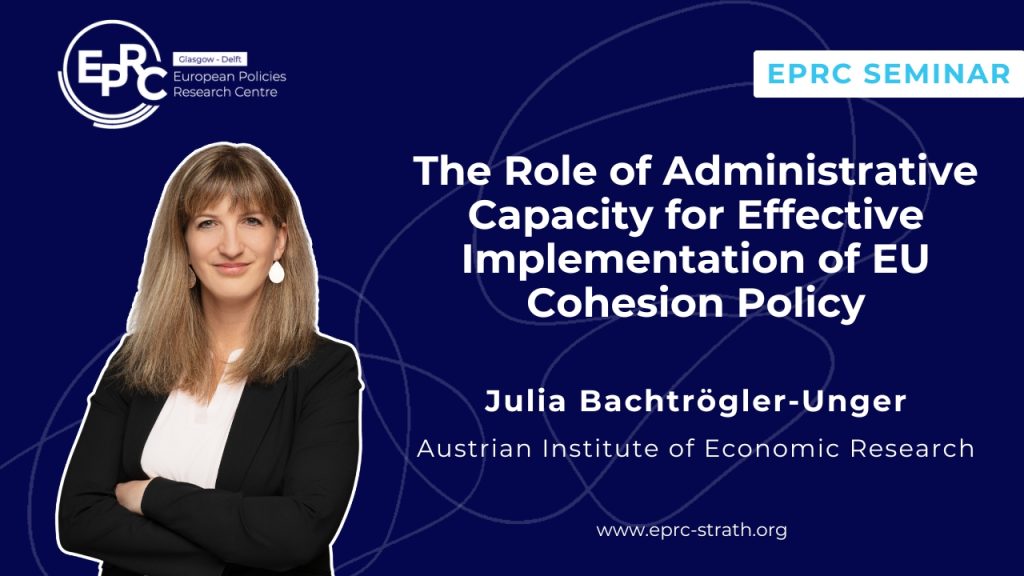
Our webinar series is back!
On the first episode of the 2025 Autumn semester we were joined by Julia Bachtrögler-Unger from the Austrian Institute of Economic Research, who presented “The Role of Administrative Capacity for an Effective Implementation of EU Cohesion Policy”.
In this episode we explored:
- How well the 2014-2020 programme period performed
- Why some regions succeed better than others when utilising EU funds
- The importance of skilled staff in coordinating funds and managing funds effectively
Bachtrögler-Unger’s presentation can be accessed here. If you missed the session you can watch the recording below or catch up on our YouTube channel.
Abstract: This reflection paper examines the influence of administrative capacity on the absorption and effective use of Cohesion Policy funds. First, it examines the current level of absorption of Cohesion Policy funds in the 2014-2020 programming period. Second, a literature review on the relationship between administrative capacity and the absorption of Cohesion Policy funds highlights the factors affecting the availability of administrative resources. Third, the role of administrative capacity for the effectiveness of funds usage in EU regions is discussed. The literature concludes that the effects of Cohesion Policy are heterogeneous across regions. Administrative capacity is an important element of a region’s absorptive capacity, also due to the project selection process through managing authorities. Therefore, measures should be taken to attract motivated and well-qualified staff and to ensure communication and coordination with stakeholders and other relevant bodies. Finally, a recent study on regional development opportunities of green and digital technologies is presented, pointing to the knowledge of administrative staff about regional characteristics and capabilities as essential contribution to “good” policy implementation.
Julia Bachtrögler-Unger is an Economist at WIFO and has been working in the Research Group “Regional Economics and Spatial Analysis” since 2018. Her research focuses on issues of regional and urban economics, in particular the analysis of economic policy measures in the regional context, regional development and convergence. In these areas she is currently working as a project leader and collaborator in national and international projects. Her current research activities include the analysis of EU cohesion policy at the micro and small-scale level. From 2014 to 2018, Julia taught and worked as a research assistant and PhD student at the Vienna University of Economics and Business. She also gained experience in two OECD projects and was a guest researcher at Politecnico di Milano. Her work has been published in journals such as Regional Studies, and gives presentations at numerous conferences and workshops. Julia was awarded the Stephan Koren Award, the Hanns Abele Prize and the FIW Award for outstanding dissertations in 2019. Since April 2022 she is a member of the Austrian Productivity Board.