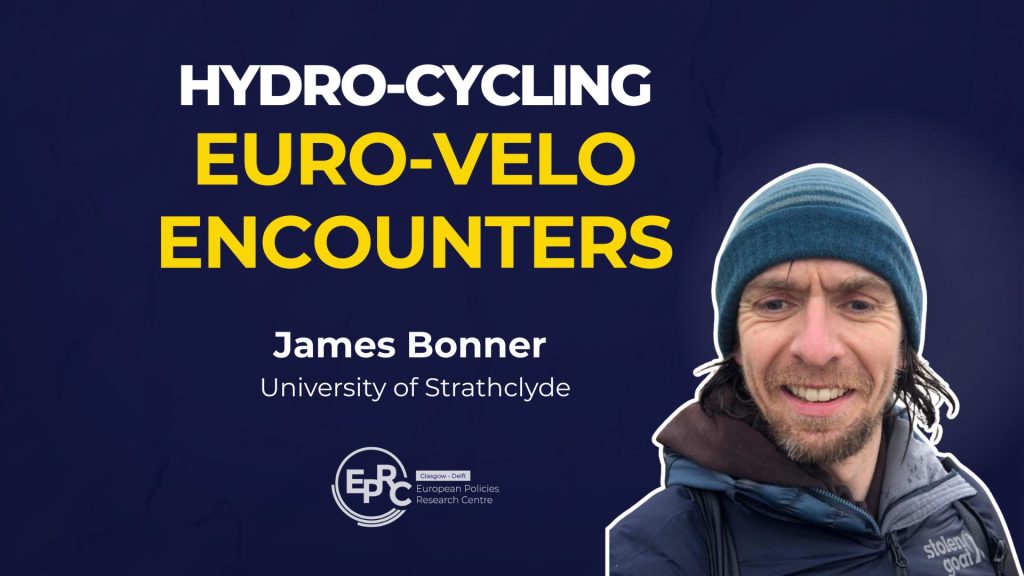
Join us for the third webinar of the Spring Webinar Series as James Bonner from University of Strathclyde presents “Cycling as a practice of movement across borders: ‘hydro-cycles’ along rivers and coasts, islands and inlets, and other encounters along the Euro-Velo cycling network”.
In this episode we will explore:
- How hydro-cycling reveals connections between people, places and waterways
- New perspectives on interregional and transnational cooperation through movement and lived experience
- How journeys can transform how we understand, study and relate to the world around us
Abstract
Can moving by bike and with water- along rivers and across seas- help inform and inspire approaches to interregional and transnational cooperation? By embodying both of their qualities of movement- flow, interconnection and cyclical processes- can cycling (and other forms of active mobility) with water help us (citizens, policy makers, researchers, practitioners…) realise our interrelationship and interdependence to each other, and foster collaborative approaches to being? As states, regions, communities and citizens, but also beyond that. As deeply entwined with, connected to, and in interrelationship with(in) the natural word.
This presentation by Dr James Bonner, Knowledge Exchange Fellow in Physical Activity and Health group, University of Strathclyde, weaves together a variety of personal experiences, encounters, learnings and future plans focused on the author’s relationship to the physical object of water, and embarked through the embodied practice of cycling. In particular, it narrates encounters, experiences, friendships, research and knowledge exchange work across Europe- both already undertaken, and forthcoming- that they have developed through this combined practice: as a means to study the world (so as a broad epistemological approach to research and knowledge exchange), but also a practice that opens up awareness of pluralities and interconnections in cultural practices and ways of being (and with ontological implications of how they have come to see, and engage with, the world and undertake their work).
He has undertaken these ‘hydro-cycles’ (a term playing on the notion of the scientific concept of the hydrological cycle– the continuous cycling of water in the earth-atmosphere system) along waterways, coastlines and between bodies of water- within and across- different countries in Europe over more than a decade. They have become a means of learning about people and places; a way of understanding the interrelationship between regions; a personal reflection and enactment of a long-standing attachment and interest to continental Europe; and an ongoing rejuvenating source of joy and vitality in being human. In this reflective presentation James seeks to share his inter/transdisciplinary personal approach to research and knowledge exchange across, and outwith, disciplinary boundaries. By adopting qualitative methodological approaches such as audiovisual autoethnography, storytelling and deep mapping as a means to narrate and depict his observations and relationships to place and the social/cultural and physical worlds as he moves, he seeks to find the spaces between the social and natural sciences, while drawing on arts-based practices and philosophical enquiries to express those.
In a short reflective tour of encounters in the past, present, and future, James will narrate some of these encounters with water and cycling in Europe.
Bio:
Dr James Bonner is an interdisciplinary Knowledge Exchange Fellow situated in the Physical Activity for Health group, part of the department of Psychological Sciences and Health, at the University of Strathclyde. His work has, in a period of over 25 years, embedded interdisciplinarity and issues of sustainability, particularly related to concepts of relationship to place. His studies and work have spanned all faculties at Strathclyde, as well as a research role at the University of Glasgow. Mobility and transport have become a focal point for his work, within and outwith, the university. He is a co-founder of the ‘Active Mobility Hub’ at Strathclyde.
After a diverse working career in public transport, mobility consultancy and self-employed research, including roles in EU Commission projects and reviewing environmental and social reporting of international organisations, James returned to Strathclyde to undertake his PhD studies in 2017. Undertaking a unique cross faculty doctorate, situated in the Department of Accounting in Strathclyde Business School and connected to Hydrology in Civil and Environmental Engineering, he pursued an interdisciplinary investigation of the broad social/cultural/ecological values of water (with fieldwork undertaken in the southern African country of Malawi)- ‘Beyond the pail : accounts of life with(in) water’ (Bonner, 2022).
Upon completion of his studies, he has undertaken variety of postdoctoral projects and roles at Strathclyde, building and developing research and practices in novel autoethnographic and participatory methods, situated in place. Projects such as ‘Every Tree Tells a Story’, as part of the university’s ‘Active Mobility Hub’, and latterly a return to work around water have resulted in exciting and commended research, knowledge exchange and guest lecturer outputs. His recent work has extended into more transdisciplinary spaces, engaging with non-academic groups within, and outwith, the university- presenting, and reflectively adjusting, his methodological approaches and practices in conversation with new audiences. This has resulted in authorship, often with a leading role in methodological design and practice, in diverse collaborative publications including: linking active mobility practices and health (Harrington et al, 2024), adopting water walks as a research method (Holstead et al, 2025), and participatory approaches connecting treescapes and citizen wellbeing (Dodd et al, 2025). Importantly, he has sought to develop outputs in engaging and novel formats to widen accessibility to non-academic audiences, including producing a digital scrapbook narrating a project connecting long-distance cycle routes in Scotland and continental Europe in ‘From the Rhins to the Rhine: Cycling Connections on the Kirkpatrick C2C to EuroVelo Route 15’ (Bonner et al, 2025) and a digital/printed map for the ‘Strathclyde Water Walk’ (Bonner and Rowland, 2026).
He likes to cycle about Scotland and beyond, in whatever the weather, looking at water, trees and art, stopping for coffee, and planning where to go next. To be perfectly honest, his cycling is often just very long routes to cafes…
His research, projects and other work can be accessed at the University of Strathclyde’s online repository: https://pureportal.strath.ac.uk/en/persons/james-bonner/
He shares his cycling and water experiences on Instagram @couchtocairn and via @strathactivemoblityhub as well as on LinkedIn www.linkedin.com/in/jamesbonner82